An Enduring Fondness for the Fairmont

When I returned to one of Fairmont’s Vancouver hotels last week, I got to thinking about what hotel chains represent in our minds - the worlds, even the eras in history, that they conjure up for us: romantic and grandiose or tacky and lowlife - sometimes all it takes is a name. The Fairmont’s portfolio contains two such properties of the romantic and grandiose kind: The Savoy in London and The Plaza in New York. Those legendary names  immediately evoke a more elegant, glamorous era. That’s what grand hotels give us and that’s why, on a harried city day,  when traffic noise, digital displays and shop windows filled with trashy mass-produced clothes are starting to get me down, I often wander into the foyer of a  grand hotel. Like Dr Who’s Tardis but for people with a hankering for marble halls, chandeliers, sweeping staircases, opulent bouquets and a bit of Cole Porter to accompany it all,  we step into another world once we go through their revolving doors.


 My first big commissioned trip as a travel writer came in 2000, from an idea that I had sent to “The Sunday Telegraph” about locations of Hitchcock films around San Francisco.  “Vertigo” featured beautiful footage of the city.   I got to follow in the tracks of James Stewart and Kim Novak.  And my first stop was at the Fairmont, San Francisco. This was the first ever Fairmont - and what a grand, gracious building it is, set right on top of Nob Hill where the cable car lines intersect. The management put me in a room overlooking the elegant Brocklebank apartments. This was where Kim Novak’s mysterious character, Madeleine, lived. Researching the feature evolved into spending  many happy hours gazing out at the glorious views of the city and I started a life-long love affair with elegant Fairmont hotels.

The Fairmonts also own all those grand hotels that waited at the end of great transcontinental railway journeys in the early days of Canadian travel. Once known as Canadian Pacific hotels, such romantic and legendary names as the Royal York in Toronto, the Chateau Frontenac in Quebec, the Banff Springs, the Jasper Park Lodge and the Chateau Lake Louise hotel all came under the Fairmont name when the chains amalgamated a few years back and the decision was made to keep the more general “Fairmont” title.  Each of those hotel names evokes New World glamour - great castle-like structures on frozen lakes or rivers with a backdrop of vast forests and mountains that were awe-inspiring but just a little menacing in their dramatic beauty. Plush warmth and comfort guaranteed a welcome release from snow and ice and train rides that could last for days. Roaring log fires, palatial dining halls, stupendous scenery viewed from a cosy window seat were, and still are, the order of the day.  Out in the gentler climes of Victoria on Vancouver Island, at the far end of the second biggest country on earth,  is the grandest old Fairmont lady of all - the Empress Hotel.

In a complete contrast, my most recent trip took me, appropriately to one of the most recent Fairmonts. The Fairmont Pacific Rim in Vancouver was built to coincide with the 2010 Winter Olympics in Vancouver. Joining the venerable Fairmont Hotel Vancouver, the glitzy Fairmont Waterfront and the Fairmont at the airport, the Pacific Rim overlooks the green grass roof of the new Vancouver convention centre. We’re a long, long way from Quebec’s Chateau, the Savoy’s Art Deco and its sedate San Franciscan ancestor.  This is a brand new 21st century hotel in soaring glass that looks out over Vancouver’s harbour, forest and mountains and takes its name from one of the world’s most dynamic regions. Over a decade after those happy days in the Fairmont on Nob Hill, I sat in my own private hot-tub, ate luxury chocolates made in-house  and gazed once again at the busy life of the worlds’s greatest ocean: Container ships from China waited in the harbour, float planes took off for the surrounding islands, joggers and cyclists headed for Stanley Park. Once again, for just a brief moment, a Fairmont had transported me to another world.




John Coltrane sets off coffee shop revolt

Artigiano is my favourite Vancouver coffee shop. They make the best coffee in town and were tracing hearts, leaves, trees etc in that perfectly thick, creamy cappuccino foam when most coffee houses thought a sprinkling of cinnamon (ugh) on watery froth would make us feel that we might just be sharing our latte with Fellini on Rome's Piazza Navona. Artigiano, with its true Italian ancestry knew better - until they let John Coltrane loose in their West Broadway branch this past Labour Day.

This was John Coltrane in his later career, his sax screeching and screaming in the wild, abrasive upper registers - and screeching and screaming, and screeching and screaming some more. The coffee shop was empty. I would later wonder if this was a coincidence. I yelled my order at the cashier - she yelled her response. Somewhere in the stratosphere Coltrane got more agitated. And so did I. As did the man in the line behind me who was muttering to his partner about "this awful jazz'. "Could you please change or lower the music?" I asked. Now, anybody who has ever asked for music to be changed knows that there is a new law in the Universe that allows a mysterious force to hold sway over music in stores, restaurants etc. And this mysterious force has TOTAL CONTROL. It is usually located out of town and does not allow the simple act of turning a volume dial ever to be performed. I know because I've asked the people in Shopper's Drug Mart if they can change their music and I'm always told that it comes "from Toronto". And Toronto, apparently, wants loud, dumb music to be played at all times.

But I'd had higher hopes of Artigiano. Their music has often been truly background, soft and smooth like the sumptuous foam on those lattes. My companion had suggested they actually switch the music off but I knew that was like asking the Queen to friend you on Facebook. You just didn't ask because you knew it would never, ever happen. The girl behind the counter had disappeared into a back room. Now she came back smiling, mission accomplished - except for one thing, Coltrane was still riffing away up in the stratosphere, getting madder and more frazzled by the minute. As were we. The man in the line behind me asked for the manager.

Enter Desiree Olexi - a very young, pleasant-faced woman. But as she strode towards us, I could see on her pretty features, the new face of customer service. Not that old 20th century model where 'the customer is always right', and the customer's satisfaction and happiness are paramount. Oh no, here came 21st century customer service. It follows the model of what I call "The New Defensiveness." This model says that "you may be the customer but we are right and we will dig our heels in and insist on how right we are even as you are walking out of the shop."

Desiree set about explaining why the music could not possibly be changed/muted/stopped by entering into a complex, technical monologue that involved a lot of incomprehensible jargon about the iPod that ran the music being broken and, apparently, stuck on John Coltrane - which every single customer in the place very obviously was not.

"You have a customer rebellion on your hands," I said, gesturing to the unhappy half dozen of us in the shop. My friend came back from seeking refuge at an outside table to report that 'it's even louder out there and the people out there hate it." But Desiree was not to be swayed. The music had been turned down, she said. (It hadn't). Today, at least, she could do no more. Perhaps tomorrow the recalcitrant iPod could be fixed.

The man behind me in the line tried a new approach. He explained, calmly and politely, that he himself works in management and the one thing he had learned over the years is that, "it is not what you are saying but how you are making the person to whom you are saying it FEEL." He looked over at me and I confirmed that I felt patronized and insulted.

But Desiree Olexi wasn't really having it. Locked as she, and so many young managers are, in the need to be right, she failed to see that the time had come for some serious damage limitation. Instead, John Coltrane won, Desiree won. We drank our two miserable lattes faster than I've ever drunk a coffee in my life, and we left. We won't be back. There's an excellent French coffee shop, Baguette and Co, further along Broadway. They serve the best croissants in town and they don't deafen their customers. I hope Desiree and John will be happy together but it's a shame things went that way. One flick of a switch, one recognition that the people who pay your wages need to be heard and my imaginary mid-mornings with Fellini could have continued. Oh, and by the way, the great Federico once commented during a French tv interview, that he could not understand the fad for background music - music while you shop or eat . "Music is for listening to," he said with a shrug.

The Last Picture Show

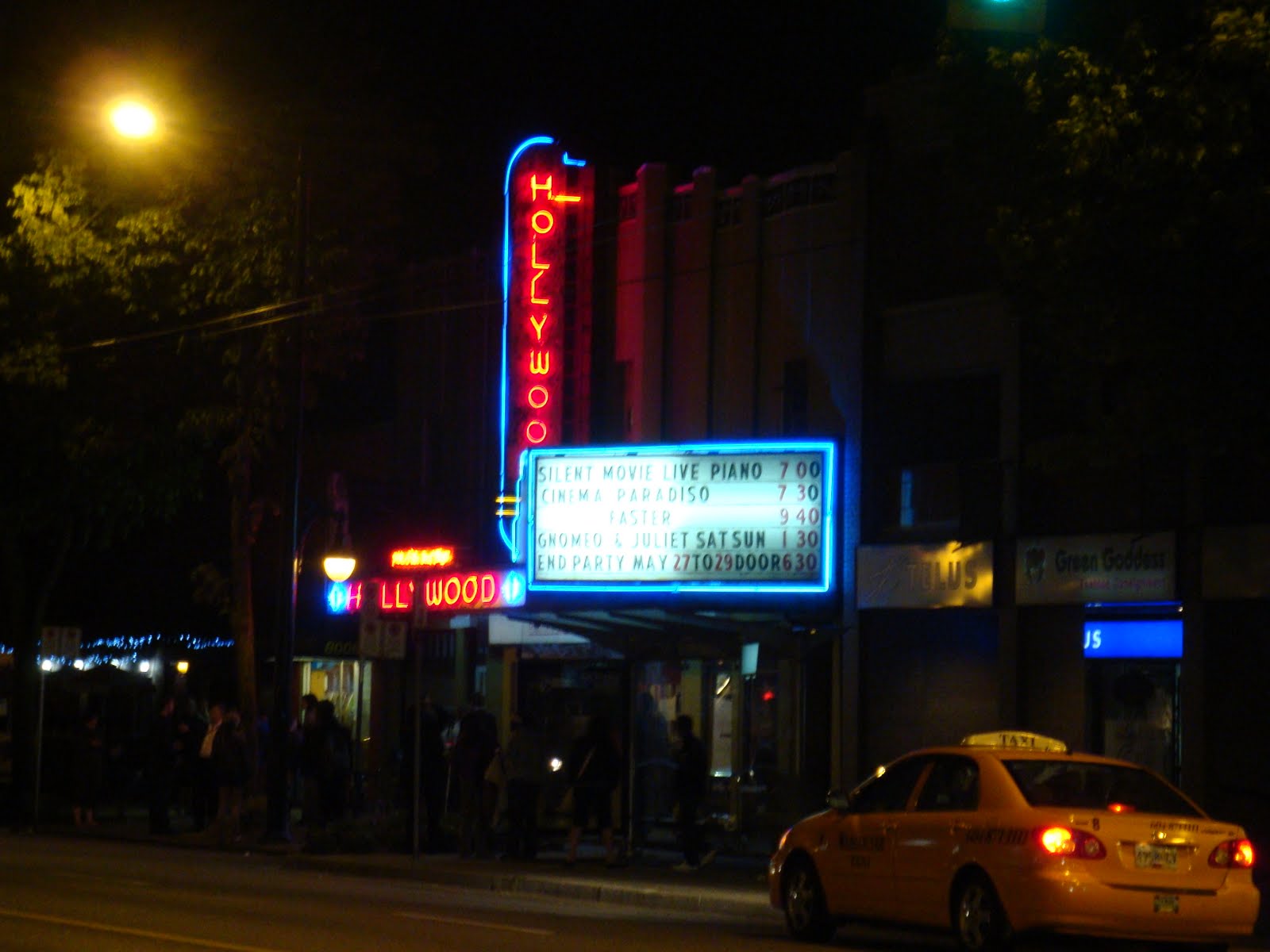
How long does it take for the smell of decades of daily popcorn to fade from the street in front of the neighborhood movie house? Our local cinema, the Hollywood, in Vancouver's Kitsilano, closed its doors forever one Sunday last April. And today when I walked past, the smell of popcorn was still there. As long as it lingers on the Hollywood's block of Broadway, it's easy to imagine, that nothing has really changed, that next Monday, as so many Mondays over the past decade, I'll buy my $6 dollar double bill ticket, my bag of popcorn and settle into one of the Hollywood's comfortable red velvet seats. The sign on the cinema's marquee is a gentle reminder that it's all over. "Farewell friends. Thanks for 75 great years."
On the last night, they asked us all to stand and sing "God Save the King" just as it had been sung 75 years ago when the Hollywood opened. And a full house of all ages stood and sang heartily. It was the least we could do. The actor MC'ing the event sang, "Smile". We'd need that over the next couple of hours as we watched the film chosen for the final show, "Cinema Paradiso", that deeply sentimental, melancholy Italian tale of the glory days of a local movie house and the changing world that brought them to an end. The changing world that has brought one of Vancouver's last local theatres to an end, is one of high rise condominiums, rising rents, a city in search of 'densifying' in order to squeeze more taxes our of the populace, and a public that is choosing to watch its movies at home.

The Hollywood sits or sat on the most villagey end of Broadway. Tall, shady trees stand higher than most of the businesses up at this far west end of this main city artery. There is something of the true far west in the eccentric single storey shops and restaurants here: Kids Books, Artigiano, East is East, Baguette & Co, a few Chinese greengrocers, Calhoun's, Parthenon, Olympic, Ace Cycles, Used Book store. And in the middle of them all stood our very own Cinema Paradiso, our Last Picture Show. It had one of those Art Deco columns and the "stripes" , the paint was peeling but the glowing red and blue neon was still beautiful, particularly in the small cursive sign over the marquee that read "Pick o' the Plays".
Rumour has it that soon Broadway's bucolic, tree-lined, single storey world will disappear. Some whisper that the city plans to run a sky train along the middle, others say that the whole block will be torn down to be replaced by condos - most likely in the 'grey and glass' style so prized by local architects and probably, poignantly called, "The Hollywood."

I'd heard the rumours but didn't think it would come so soon. Like all human beings, I like to believe that my sources of pleasure and comfort will go on forever - even small, slightly shabby pleasures like sitting in the Hollywood in Vancouver-damp clothes on a Monday night, wondering whether I should have paid an extra 50 cents and got real butter on my popcorn. And wondering whether I'd have the stamina to sit through the double bill and only managing it once.
An architect friend of mine was also a regular. When I discussed the closing with him, he said, "Well, I'd love to say come along to the last show with me but frankly that's something I want to do on my own. I want to sit in my usual seat, eat my usual popcorn and just say a quiet goodbye to the old place alone."
Movies are, after all, a very solitary experience that we share with others. So he went on his night and I went on mine. And we said goodbye to the kitschy mini-chandelier in the tiny foyer, to the box office that looks out on the street with its fading postcards of French New Wave movies - Brigitte Bardot in "Le Mepris". And to Alice the 92 year old grandmother who has sat in that box-office for so many years, selling those tiny little pink and blue paper tickets that have been demoted to cloakrooms and raffles in the rest of the world.
Last night as she posed for her umpteenth photo, clad from head to toe in scarlet, she whispered to me, "Oh I would hate to be a movie star. They have to do this all the time you know."
And good bye to the big clock to the left of the screen. I could always gauge the power of a movie by the number of times I looked at that clock. During "Lost in Translation", halfway through the film I concluded that the clock might actually be more entertaining.

I've commented on this before but North American culture is not fond of farewells. Sadness does not sit well with a people programmed for positivity, for new starts and looking towards the future. But surely, feeling the loss of something or someone is part of being human. This insistence on being perky and upbeat at all times and at any cost diminishes us as people. And so at the Hollywood last night, we called on the Sicilians to help us grieve our very real loss. You could hear the sobs and the rummaging for extra Kleenex as the Italians gathered in their piazza to watch their Paradiso be demolished.

But afterwards, as we poured out into the street one last time, eyes were wiped dry and everyone was brisk and upbeat...and a little at a loss as to what to do or say. For a few brief moments, so many of us were taking pictures of that wonderful old marquee and the red and blue neon sign, that we spilled onto the road and held up the traffic. But it was only for a few seconds. The order was established, the Broadway buses could pass and for the final time, we all made our way home from the local movie house.

Raw Food: If it's good enough for Hugh Jackman....

This was the first assignment in a 12 year travel-writing career that I almost turned down. When I heard about the Fresh Start health retreat at the Ocean Resort on Vancouver Island, I had a vision of wafting along cedar-scented corridors in a cosy robe - from a massage to a facial to a leisurely steam or sauna. Maybe a glass of wine as the sun sets over the Pacific and a light healthy spa dinner of salmon and veggies.

Then I found out that I was headed for 5 days of juicing detox. No wine, no salmon, no tea, no coffee, nothing cooked and cosy - just juice. Juice and yoga and long walks along the ocean, and films on food and our civilization's chequered and troubled relationship with the subject. The directors of Fresh Start planned to spend a couple of days sorting out my liver, then a day on my stomach and another one on my joints and skin. (Oh, there is a sauna session where they bathe your feet in cedar-scented warm water so there's a promise of the usual spa pleasures but would it make up for the lack of food?)

"My liver is just fine, thank you very much," I told them as I secretly planned to have a non-existent aunt die on me and be forced to cancel my attendance.
"Think of it as an oil change," they replied. And despite myself I did. And it was an extraordinary experience. I'll post the link to my feature about the Fresh Start experience, and the conclusions I've come to, as soon as it's in print.

On the day I returned, the Globe and Mail ran a feature on raw food and informed us that Hugh Jackman transformed his gorgeous self into the magnficent hunk in "Wolverine" by changing to a raw, mainly green foods, diet. So there you are.

And the place was gorgeous - salmon were leaping out of the Pacific in front of my window, a resident eagle hovered above the nearby woods and the views of the mountains across the water are ceaselessly shifting and changing and are ceaselessly spectacular. I'll try to post a picture later today.

Guide to Good Things in Vancouver - Spring 2010 update

Well, the Olympics came and went and life as we know it here on the West Coast of Canada seems to have gone on as usual. My personal experience of the Games seemed to consist of a lot of going out and "looking for the Olympics." I could see the flame even if it was behind an ugly chain-link fence; after each hockey win for Canada, I could certainly hear the crowds. The lines in front of the Russia House, the House of Saxony, the BC Pavilion, the Mint and even for the non-Olympian Leonardo at the Art Gallery, confirmed that something was going on but, as is so often the case in life, I had a sneaky feeling that the real deal was going on somewhere without me. In the meantime, most of the really good things in Vancouver remain and are accessible and reliably delightful as ever. These are in no particular order. There are some new ones too. I'll start with, and say a little more about, the latest additions:

1. Xoxolat at 2391 Burrard. (www.xoxolat.com) I know they've been there for a while but I've just discovered them and what a discovery! I wandered in on a rainy April afternoon and talked to "Chief Chocolate Officer" Hodie Rondeau about chocolate. Sometimes, you just feel like talking about chocolate and on those days, Hodie is your woman. Unlike that other great temple of chocolate around the corner, the iconic Chocolate Arts which specializes in making its own, (see below) Hodie's Xoxolat also imports some of the finest makes of chocolate from chocolatiers around the world. Try the French Pralus brand's chocolate covered cocoa beans or select one of the wildly eccentric bars from Austrian Herr Zotter's range -avocado and mandarin yogurt?

2. Baguette & Co at 3273 West Broadway is a real French bakery. You've seen hundreds just like it all over Paris. The 'boulanger' Adrien Fabre is from Montpelier, the Patissier, Thibault Champel, is from the Ardeche. So, finally, it's possible to buy a croissant in this town that is not the size and consistency of a bath sponge. Phew!

3. Coast restaurant at its new location on Alberni St. The ever-dynamic Glowbal group recently shifted Coast from Yaletown to this downtown location. They still serve some of the best seafood in town and they add nice touches like telling you who caught what and where. (Jay Gold on the "Miss Venus" caught my sablefish). The "fish and chips hand roll" on the sushi menu is not to be missed - like Willy Wonka's magical candies, it delivers all the tastes and textures of fish and chips in an elegant little sushi cone. If you can, sit in the upstairs gallery. It's like being an audience member in a front-row seat at the big, exuberant show that is Coast. www.coastrestaurant.ca

4. Chocolate/raspberry tart at Caper's - Caper's has one of the best pastry cooks in town - add to that seriously dark chocolate and a not too sweet raspberry coulis and you have a tart worthy of Paris (said the bishop to the actress). And I know it's Whole Foods now but not here.

5. 'Fresh is Best' salsa, guacamole, chips etc on 2900 block Broadway in Kitsilano - their tortilla chips are so fresh and crispy- best I've tasted, their guacamole with a hint of cilantro, and salsa are 'squisiti' as the Italians say.

6.Baked chicken samosa at Choices. Beware, the kids in the deli are ALWAYS mixing up the chicken and veg. But since the veg is a lot of spicy potatoes and a few peas etc, the ground chicken is a much better bet and baked so not too greasy.

7.Chocolate Arts - chocolatier 2037 W 4th - elegant, original and utterly delicious. Nut-types rave about the "splinter" roast nuts in chocolate. I love the lemon-basil truffle. Best chocolate in town.

8. Cornbread at Terra Breads on 4th or Granville. I once had some French friends who arrived in town, sniffed, as the French are wont to do and headed out in search of 'real bread'. They came back with baguettes from Terra but the cornbread is fabulous - with onions and cheddar cheese or is it Asiago? Oh damn - will have to go buy some and see.

9.View from The Galley cafe at Jericho Yacht Club. Just a caf with self-service good, basic food and the most jaw-droppingly beautiful view in Vancouver.

10.Caffe Artigiano - opposite the Vancouver Art Gallery on Hornby or on Broadway - best coffee in town. Get your lumpy bums out of Starbucks this instant!

11.The restaurant at Vancouver Art Gallery - most elegant and reasonably priced lunch place in the city. Lunch on the terrace surrounded by flowers and ornamental trees with a background of classical music is a spring and summer treat.

12.Kits' Pool. Summer is approaching and I had to list something other than food. Blimey this thing is big! I felt like I'd swum in from London first time I completed a length but what a setting - it looks out on snow-capped mountains, Stanley Park and, the Pacific Ocean.

13. Various Chinese produce stores on Broadway between MacDonald and Alma. I favour Golden Valley, sometimes Tim's. Young's has the biggest following but the noisy music, surly staff and long lines don't make it worth the few cents I might save. New Apple Farm always seems to be a bit more expensive.

14. Sambal green beans at Banana Leaf - you can feel virtuous by getting your veggies and still eat one of the tastiest dishes on this very popular and good menu.

15. Hollywood Cinema on W. Broadway in Kitsilano - $5 for a Monday night double bill in this family-run Art Deco treasure. The Last Picture show lives on here in Kits.

16. The pizza at the Olympia Greek restaurant on Denman - delicious crust, generous helpings.

17. Still on pizza - Rocky Mountain Pizza Co - out of Canmore, Alberta and frozen in stores here or at their restaurant
at 1st and Cypress.

18.Gruyere and Mushroom tart at Coco & Olive on Broadway at the far end near Collingwood. Another truly French establishment. He is pricey and servings seem to be getting smaller but this tart puts your average bland quiche to shame.

19. Go Fish - fish and chip shack at Fisherman's Wharf near Granville Island - the days are getting warmer and a basket of fish and chips by the water here is a Vancouver summer treat. Bald eagles sometimes hover enviously in the skies above.

The Slow Death of the Best Block in Kitsilano

I've been keeping track of the comings and goings in this city for almost a decade now.
My neighborhood of Kitsilano has seen some of the most dramatic changes. I'll list some of the more interesting newcomers in an accompanying post but first on a sadder note, it's time to say a fond farewell to Duthie's and note the demise of one of the most delightful blocks in the city: 4th Avenue between Yew and Vine.

For years this hundred or so yards contained great music in the form of The Magic Flute - a store that was worth a visit for the magnificent pan-piper door-handles alone, Duthie's books, fine wines at the Kitsilano wine shop, good local food at Capers, and in the Coast Mountain adventure store, a reminder that this young, brazen city of Vancouver is only a very recent and temporary guest in some of the wildest, most majestic mountain and ocean landscape on earth.

Great music, great food, great wine, great books and great landscapes - the block once had everything necessary to feed the soul.

The Magic Flute was first to go - brilliant and dynamic local entrepreneur and owner David Lemon foresaw the collapse of the music business a few years before it happened and sold the shop. It limped on for a while but the CD business was being killed by the internet and soon music was gone.

Next out was great local food in the form of Capers. Yes, the store is still there - it's name is still on the awning but Texas-based Whole Foods bought it out and any recent shopper will see that the old, cosy store with its more cramped aisles and higgledy-piggledy lay-out has given way to a more spacious, generic supermarket-style design. Sometimes, when I am tired or distracted, I can mistake the displays for similar ones in Whole Foods on Kensington High Street back in London. So much for a neighborhood store.

The Coast Mountain store went next. You can stand right next to where it used to stand at the top of Yew and 4th and gaze out at the snow-capped summits and the Pacific Ocean but the store with its tents, sleeping bags, hiking boots, and all the rest of the paraphernalia that allows man to approach those mountains has gone.

And then, one of the saddest farewells of all, took place when Duthie's books closed in February of this year. From being a vibrant local chain to this one surviving store, Duthie's decline had been obvious. But I'd hoped against hope that they would survive. Books, we are being told on an almost daily basis, are going the way of the CD in this internet age. Duthie's held on until their knuckles were white. Then they fell and died.

Now the wine store remains but the rest of the block has gone from a nourishing place for the soul to purveying mass-produced clothes for our bodies and trinkets for our homes. Twas, perhaps, ever thus in Vancouver - the cult of the body takes precedence over the life of the mind. But for a few wonderful years, on a fine autumn day when the leaves on the trees that line 4th Avenue turned scarlet and the air took on that golden September tinge, you could walk just a few dozen yards and find the latest Douglas Coupland or the new Hilary Mantel, a fine bottle of Barolo or a home-baked raspberry and rhubarb tart, a tent to shelter you from the Pacific Northwest rains, boots to climb those snow-capped summits and some Beethoven to give you the courage and energy to set out. Everything in fact that a happy human being might want.

Guide to Good Things in Vancouver

Listed in no particular order - as I think of them or find them:

1. Chocolate/raspberry tart at Caper's - Caper's has one of the best pastry cooks in town - add to that seriously dark chocolate and a not too sweet raspberry coulis and you have a tart worthy of Paris (said the bishop to the actress). And I know it's Whole Foods now but not here.

2. 'Fresh is Best' salsa, guacamole, chips etc on 2900 block Broadway in Kitsilano - their tortilla chips are so fresh and crispy- best I've tasted, their guacamole with a hint of cilantro, and salsa are 'squisiti' as the Italians say.

3.Baked chicken samosa at Choices. Beware, the kids in the deli are ALWAYS mixing up the chicken and veg. But since the veg is a lot of spicy potatoes and a few peas etc, the ground chicken is a much better bet and baked so not too greasy.

4.Chocolate Arts - chocolatier 2037 W 4th - elegant, original and utterly delicious. Nut-types rave about the "splinter" roast nuts in chocolate. I love the lemon-basil truffle. Best chocolate in town.

5. Walnut bread at Terra Breads on 4th or Granville Island

6. Cornbread at Terra Breads on 4th or Granville. I once had some French friends who arrived in town, sniffed, as French are wont to do and headed out in search of 'real bread'. They came back with baguettes from Terra but the cornbread is fabulous - with onions and cheddar cheese or is it Asiago? Oh damn - will have to go buy some and see.

7.View from The Galley cafe at Jericho Yacht Club. Just a caf with self-service good, basic food and the most jaw-droppingly beautiful view in Vancouver.

8.Caffe Artigiano - opposite the Vancouver Art Gallery on Hornby or on Broadway - best coffee in town. Get your lumpy bums out of Starbucks this instant!

9.The restaurant at Vancouver Art Gallery - most elegant and reasonably priced lunch place in town. Lunch on the terrace surrounded by flowers and ornamental trees with a background of classical music is a spring and summer treat.

10.Kits' Pool. Summer is approaching and I had to list something other than food. Blimey this thing is big! I felt like I'd swum in from London first time I completed a length but what a setting - it looks out on snow-capped mountains, Stanley Park and, the Pacific Ocean.

11. Various Chinese produce stores on Broadway between MacDonald and Alma. I favour Golden Valley, sometimes Tom's. Young's has the biggest following but the noisy music and long lines don't make it worth the few cents I might save. New Apple Farm always seems to be a bit more expensive.


12. Sambal green beans at Banana Leaf - you can feel virtuous by getting your veggies and still eat one of the tastiest dishes on this very popular and good menu.

13. Hollywood Cinema on W. Broadway in Kitsilano - $5 for a Monday night double bill in this family-run Art Deco treasure. The Last Picture show lives on here in Kits.

14. The pizza at the Olympia Greek restaurant either on Denman or Broadway - delicious crust, generous helpings.

15. Still on pizza - Rocky Mountain Pizza Co - out of Canmore, Alberta and frozen in stores here or at their restaurant
at 1st and Cypress.

16.Gruyere and Mushroom tart at Coco & Olive on Broadway

17. Go Fish - fish and chip shack at Fisherman's Wharf near Granville Island - the days are getting warmer and a basket of fish and chips by the water here is a Vancouver summer treat. Bald eagles sometimes hover enviously in the skies above.

Return to Vancouver

On my first morning back in Vancouver, I turn right out of the house in Kitsilano, look north and there they are -seemingly at the end of the street: Vancouver's three great mountains - from left to right - Cypress (or Hollyburn) Grouse and Seymour -all snow-covered on this rainy morning down in the city.

I've left the mayhem of London - of Ealing to be precise. I'm no longer one of the teeming crowd that stream out of Ealing Broadway station every minute of every day. I'm far from the smells of the falafel shop on the corner and the gloom of the shopping precinct where every week seem to bring another vacated premise. I've exchanged the possibility of a London day - a quick hop on the Central Line and in 25 minutes, there's the British Museum - for the green, peaceful streets of Kitsilano - once Vancouver's answer to the hippy Haight Ashbury in San Francisco.

Now the evening offers "Marley and Me" at the family-run Art Deco, Hollywood Cinema on Broadway - $6 on Monday for a double bill - Marley is followed by "The Day the Earth Stood Still." It's a far cry from trying for a ten quid standing place at the Royal Opera House but I'm relieved to be gone. Nobody here is braying about dead reality tv performers. Nobody cares about the bloated over-paid likes of Jonathan Ross or Fred Goodwin.

When I shop, I don't have to rely on Mr Sainsbury, Mr Waitrose, Mr Tesco or Mr Asda to feed me. Broadway, the main street round the corner boasts half a dozen excellent Chinese greengrocers - mangos at 50p and the owners all know me and ask how I am. Coffee at Whole Foods costs 90p. Add to that, a chocolate-raspberry tart and it's five minutes of paradise, Crab cakes at the Seven Seas fish store are as good as in any restaurant and cost less than £2. Terra Breads in the same block sells a walnut bread that surpasses any I've tasted in Paris.

And all the while the snow falls on those mountains and the forests of great cedars and pines, the Pacific laps at the end of the street and there's not a red-top tabloid newspaper in sight.

Blissful BC courtesy of David Attenborough and the BBC

Nature's Great Event last night, viewed from the Ealing living room, was the salmon run in BC.   Bears, wolves, eagles, orcas and the salmon themselves paraded before me on the tv.  How rare and exotic they looked after an afternoon on the Central Line. And how exquisitely beautiful was, as always, British Columbia. So green, so blue, so many trees, so many mountains, so much water.
I've had a suspicion for years that if BC were in the USA where they are so much more inclined to self-promotion, the place would be a mob scene. But it's those reserved, self-deprecating Canadians who won the Majestic Landscape lottery. And they have, on the whole, spent it in quiet sensible ways.  (Yes, yes I know ...clearcutting, Sea to Sky Olympic massacre but Greenpeace was born in Vancouver.. and vast swathes of BC remain untouched and inaccessible)

London  life feels so small-minded and banal when confronted with the drama of grizzlies descending snow-wrapped mountains to wait on the shores of sparkling rivers for the arrival of the fish from thousand of miles out in the Pacific. Fish who are compelled to return to the exact place of their birth to spawn and die. On the way, BC's spectacular wildlife  - wolves, orcas, eagles and grizzlies will kill  many of them but the salmon persist, growing pink and uglier as they do. And when they die and rot and their carcasses are devoured and scattered by scavengers, their remains sink back into those lush green forests, feeding them the precious nitrogen that gives us the great cedars, sitka spruce and western hemlock that make up these glorious forests. Round and round goes the green and blue cycle.

On my first summer in Vancouver,  I was astounded to see  whole wild salmon on sale in the Safeway for about $3. The run had been spectacular that year and we, the blundering bipeds were also getting our pickings right behind the grizzlies and eagles.

When I come out of that Safeway, if I look down the hill on which it stands, I can see mountains and forest and ocean. How lucky I am that for just a few months each year, I get to live alongside such grandeur, such ongoing spectacle.

Blissful Vancouver Sundays - without the Sunday papers

I'd been going back and forth to Vancouver for 7 years when I suddenly realized why Sundays in Vancouver felt lighter and cheerier than Sundays in London. Of course, in the Canadian city I can see the snow on the mountains when I wake up. And in winter there's the prospect of snow-shoeing on those peaks - in summer there's a dip in the Pacific at the end of the road. But all the Lotus-land pleasures of BC aside, the one enormous difference is that nobody bothers with Sunday papers in Vancouver. This pathetic ritual of loading a stonking great pile of dead tree into your supermarket trolley and lugging it home to read all those opinions of all those dried-up poseurs  would be unthinkable in Canada. The leading national paper, The Globe and Mail doesn't even bother publishing a Sunday edition. 

I remember once reading a Stephen Fry column (in something like the Spectator NOT a Sunday paper) where he said that he had found himself becoming increasingly more depressed by the Sunday press - all those dismissive opinions - all the cynicism - and had finally called a halt and felt better for it. The prospect of a hike up Mt Seymour makes it easy to ignore the press but even in London, I think the time would be better spent picking dry skin of the soles of my feet.

And yes, I do occasionally write for said Sundays. And I do my best to make my stories witty and informative. I'm happy that people read them but I'd rather they were read over a cup of tea and a bun after a good walk in the woods. And the Style section should definitely be used to wrap the fish and chips that the food section probably tells us we should no longer eat.

Posted by Janette Griffiths
at 14:34

Green with envy of a White Christmas

I turn my back on Vancouver for one minute (well 3 months to be precise) and what happens??

All my life I have yearned for snow at Christmas, and for most of my Christmases, I've opened the curtains to look out at rain, brown bare trees, bilious grey clouds and the prospect of a day watching foul British tv in an overheated house with the family getting increasingly more cranky as the blood sugar and cholesterol levels rise. I remember  being 5 years old and being walked to a relative' s house - head raised to the heavens all the way searching in vain for snow and a star from the east. The scene was set for Christmas to be a time of sinking disappointment.  I gave up on the star when I gave up on God but I've always kept that hope for snow.

SO....after that long preamble, I CANNOT BELIEVE that I turn my back for a few weeks and Vancouver comes up with the whitest of Christmases. I know that most people hate the cold, I know it is inconvenient but I feel cheated and couldn't be more jealous if all my Vancouver friends had won that 6 4 9 lottery thing.  Envy works both ways: I have a friend in Vancouver who longs for what he imagines is my London life of Wigmore Hall concerts and evenings at the Royal Opera. I try to tell him that a couple of hours of great music have to be balanced against living in the crude, crowded, crass mayhem that is 21st century London.  He would tell me that winter wonderlands wear thin when you have to shovel the driveway and scrape the car. He is right. He is a grown-up where snow is concerned. I'm a  child. The love of snow is the one remaining vestige of my childhood. And so for the next few days, I intend to call on a child's strategy to deal with the annoying stream of emails from the Canadian west coast describing snowy walks in Stanley Park and attaching photos of 'Kits' Beach in the snow.' I'm going to cover my ears with my hands and sing loudly until my beloved white stuff has turned to standard-issue Vancouver rain. 'La, la, di, da'...

Requiem for Radio 2

Radio 2's long goodbye lasted all day yesterday. To be precise it lasted until 6pm. Everyone I know turns off that excruciating Katie Malloch and her insulting habit of telling me how I feel and what I'm doing: "You're driving home from work and you feel the need for...etc banal, mundane etc". At this point I have long since told the tedious creature to "STFU" and from 6pm onwards the radio was switched off. But Tom Allen felt like a friend and to listen to him mouthing the party line as he wound down "Music and Company" was sad and wrenching. No, many, many of us won't be coming with you Tom, not to listen to music that I can hear in the shopping mall or the supermarket. Tom, the former trombonist, taught me a lot of what I now know about classical music. Thanks to him, I can take that knowledge off to the internet and listen to BBC Radio 3. But it's not the same.

In his movie, "Radio Days" Woody Allen evoked the magic of a population linked by sound, by the voices coming out of the box in the corner. Of course those days are long gone but CBC's Radio 2 managed to continue the tradition. True it united people who love Beethoven, Bach, Brahms etc but what fascinated me when I first arrived in Canada seven years ago and discovered the then wonderful station, was just who these people were. The farmer on a Sasketchewan prairie who requested the Goldberg Variations,
the sculptor in a studio on a lake in Ontario who called, as so many of these cold country Canadians did for Sibelius, and the truck driver on the Trans-Canada who needed some roaring Beethoven to fill him with the energy to cross that vast, dark, transcontinental night.

Ah, but the apologists for the dog's breakfast that will be the new Radio 2, insist that they will provide the same service. Right - by giving us a mish-mash of music that can be found on commercial stations everywhere. Anyone who has ever been on a cruise knows that smorgasbords get very boring very fast. The sight of taramasalata, bean salad, smoked turkey, lasagne, chicken tandoori and ribs may look alluring on the buffet but once you've got that heaving mass on your plate it becomes strangely unappetizing.

And, throughout this whole miserable episode, nobody, with the noble exception of Russell Smith at The Globe and Mail, has dared to say that what we call Classical Music , for want of a better word, is superior to a lot of contemporary music. Something happened in the late 18th and 19th centuries that carried this art form to a summit. I'm not saying that there is only one mountain out there and another summit may well be reached at another time. But the vast mass of pop, rock etc has not got half way up the nursery slopes.

Yesterday, during one of the sad farewells ( was it Eric Friessen on Studio Sparks?) somebody played the Schubert String Quintet in C Major. I first heard this on BBC's Desert Island Discs when novelist Stan Barstow described it as music he would like to die to. It contains within it, a sense of the infinite and the eternal. And, unlike the four beat in a bar commercial pap that I am now being told I must love, never, EVER becomes an earworm - one of those infuriatingly banal tunes that get inside your head and make you want to rip it open and tear the thing out.

So CBC Radio 2 played the great Schubert piece and died before our very eyes. Goodbye Tom, goodbye Shelley (for we all know that Here's to You really died last year when the great Ms Solmes took her leave) goodbye to Jurgen and goodbye to the often too pious and smarmy Eric Friessen. (But Eric, you redeemed yourself in spades this week - the Brahms, William Styron reading was heartwrenchingly beautiful.)

Yesterday felt like a day-long requiem. I know I am not the only one who feels bereaved on this late-summer Saturday morning. Something noble and beautiful that linked this vast land is gone forever and the land is duller and darker without it.

The Last Summer of the Bed and Breakfast

On August 16th, Graeme's  House - at 22 years, one of the oldest inns in Kitsilano, closed - probably forever.

For the past 4 summers I have cleaned the place. Four summers before that I was at a dark and scary crossroads: mother dead, career flagging, love lost. I did the 21st century rounds of seers and sages. If one of them had predicted that in the very near future I would cross an ocean, land in one of the world’s loveliest settings for a city and be cleaning toilets every morning of every summer for four summers, I would have asked for my future back.

When Graeme (and yes she’s a woman - it’s a Scottish thing apparently)approached me with this proposition, she described it as ‘doing a Monica Dickens’. Graeme’s generation is probably the last to know what that is. Monica Dickens was a granddaughter of Charles; she took on humble jobs like cleaning to gather copy and write a lot of novels.

I did not want to write a novel about cleaning or cleaners. I did not want to write a novel about Bed and Breakfasts. I did need some quick extra money though, and one morning in early May found me following Graeme obediently through each of the four rooms learning how to make a bed with hospital corners - tuck in the bottom of the sheet, pull up a lower corner until it is the shape of a bishop’s mitre, tuck that in. The bed will look a lot like a neatly wrapped package. The guest, one must assume, will be overcome with an urge to become the contents.

The falling blossoms of an apple tree out on the deck signalled the beginning of my work each year. The proliferation of berries on the mountain ash in the back yard heralded the end. Sometime in September, I would look out of the window in the Rosedale Room and see that a scarlet breath of autumn had blown through the maple on 11th Avenue. By then there would be two or three guests in the house as opposed to the eight or nine that would squeeze around the kitchen table of an August weekend. 

The guests came from  all over the globe from Australia to  Finland, Switzerland to Taiwan. They would stumble in jet-lagged from a flight from Heathrow, alight from a taxi after an Alaskan cruise or drive up Waterloo Street straight from the Rockies in their camping car. They were physicists, orthopedic surgeons, psychics,  ecologists, neurologists, peripatetic grandparents, poets, lobbyists, toddlers, teenagers and new-born babies. They were very  rarely Republican. We did have two con men (not together) and one drunk but in a 22 year stint, they are barely worth a mention.

They were all invariably delighted with their stay. Other B&Bs may have been bigger, or have offered sherry at twilight or eggs Benedict for breakfast but very few had Graeme's gift for making people just plain happy to be in her home.

"We are all in this dance together," Graeme would say as she got up at 5am to serve breakfast to some early ferry passengers or allowed a trio of twenty something Finnish mountain bikers to take over the kitchen  and  fill the genteel Cornflower Room with a mountain of clothes and, what looked like armour, for their week long stay. 

"This is my life's work", remarked this former art teacher, English teacher, practicing therapist and interior designer one morning.  I paused, dustbuster in hand, ready to argue that she was far too clever, too qualified to be baking muffins and making beds. But I had failed to understand what Graeme had understood: that true hospitality - giving shelter, a room at an inn is one of the most  viscerally important and loving roles on the planet.

Graeme also gave shelter to the venerable Puhd - the black cat who wandered into her house during a blizzard and stayed to meet and greet and occasionally sleep with the guests for 21 years.  Puhd left us 3 years ago and can never be replaced  but in lush, verdant Vancouver where coyotes roam the lanes and bald eagles can sometimes be glimpsed in the sky over Graeme's house, the wild life endures.  Hummingbirds will continue to whirr round the petunias on the deck. Our neighbourhood raccoon will pursue his ambition to steal the back doormat.

But when the last of the guests wheeled their suitcase under the floral arch and down the garden path one Saturday morning last August something was lost forever in this lovely little Vancouver neighbourhood of Kitsilano.

 In this perenially perky North American culture, there is not much room for sadness, there is little room for the sense of endings. If something ends, we must rush to see what is about to begin. If one door closes, then by golly, another one had better be opening before we've had time to catch our breath. We might nod in the direction of 'closure' but we don't really care for the bittersweet emotions of an end. Melancholy, that autumnal sense of the extraordinary sadness of our human condition - as soon as we live and love something, anything, it is already slipping away from us - rarely makes an appearance on Oprah.

Well, this summer, something quite lovely ended on Waterloo St. I never thought, when I was grumbling my way through the bathrooms, dustbuster and toilet brush in hand, that I would miss these mundane tasks but they proved, like the B&B and like Graeme herself, to be rather good for the soul. So, time to mark  a moment of sadness and say goodbye to the hospital corners, the colour co-ordinated towels, the cheese muffins and the blueberry scones, to the endless slivers of left-over soap and the bottomless pot of coffee; to Puhd and the racoon and to all those strangers who came up the steps to sleep and snore and dream for just a few short hours before going on their way. Now Graeme goes on her's - off to some other adventure I am sure.  But her lovely house will be much missed.  Farewell Graeme's House - it was a privilege and a joy to know you.


Rockwater Secret Cove Resort - My hour in the Jacuzzi


I'm in a tent with a Jacuzzi. This is not a kinky choice of camping partner or the tight squeeze that it might sound. The Rockwater Secret Cove Resort on British Columbia's Sunshine Coast has pitched a colony of tents, each the size of a small cottage, on a bluff overlooking the Pacific. The tents are reached by a wooden boardwalk that starts out at the Zen-like stone garden. You pass through a mini-Stonehenge- and head up the boardwalk until it becomes a treewalk and you find yourself slightly above the foilage, on a level with the branches of hemlock, cedar and arbutus that cover the cliffs. The Pacific is off to the right, the tents are scattered here and there, some up, some down among the trees.

A big bronze bell guards the entrance to each tent, the entrance is an elegant French double door, the floor is cool earth-toned stone, the bed vast and inviting. In case you forget that you are in a tent, there are numerous zip-up windows that open up with views of the ocean which, this being a tent, you can hear crashing against the rocks.

And there's the jacuzzi - a few feet from the bed with its own view out onto the forest at one end and onto the sea at the other. It comes with an instruction manual and a control panel, even a remote control. As I prepare to step into the tub, I am quite sure that I will need none of them. How difficult can it be to take a bath with a bit of whirling water thrown in? I'm probably one of the few occupants of this tent to come alone. Children are not allowed; the boardwalk would rule out the old and infirm so the target market is obvious. The tents are meant for romantic rendezvous. And so, of course, is the jacuzzi.

Oh well, as a travel writer, I'm used to being alone in romantic spots. I've lost count of the number of times I have dined alone by candlelight while couples gazed across the flames at each other and I begged the maitre d'hotel for half a dozen candles so that I could see to write my notes.

I decide to give the jacuzzi a try. It is not yet twilight and I fancy bathing and gazing at the ocean. The tent comes complete with a CD player. I put on a Dvorak string quartet to set the mood, run the water and step in.

Hmmm. That control panel is more complicated than I thought. I may need the manual after all. Also, there is a difference between the two ends of the tub. One, facing the forest has a little seat. Perhaps better positioned for the massaging jets. But I want the view of the ocean. I've worn my glasses to that purpose. Now I'm glad I've got the glasses because the instruction manual is substantial. But before I plough through it, I see a button saying "color" on the remote.


For one wild moment I imagine that coloured water will pour from the taps. But no, a string of red lights have lit up around the inside of the tub. What with Dvorak and the lapping of the waves, it's sort of a soggy "Son et Lumiere." The instruction manual says that I should press a second time to choose colour. I press and press but seem to be stuck with the vivid red colour. "If in doubt, press everything," has always seemed a good rule of thumb so I hit a few more buttons - the red stays but I have activated a very violent set of jets . The manual gets washed to the floor. My glasses disappear into the maelstrom. The remote control has slipped under the tub.

I need to head for the fixed control panel at the far end of the tub. I set out - it is like swimming up a waterfall. The noise of the jets has drowned out my Dvorak. When I finally reach the control panel, I realize that it will mean nothing without the manual. The manual is lying in a puddle on the floor at the other end. I head back. I seem to be travelling with the current this time so make it to the puddle in a matter of seconds. While I'm at it, I fish for the remote but that has slipped beyond my reach. Clutching the manual above my head, I set back out for the fixed control panel. But once I arrive, I realize that without my glasses, still whirling somewhere in the water below my feet, I can't read the manual. I rest my weary head against the controls and decide to try the color button again. After a few presses, I get blue, then green and soon the whole rainbow kicks in - purple, indigo, gold, pink, green.

Happy and encouraged by my light show, I fiddle with the massage buttons again. They too, seem to have calmed down, and seem to be pummelling politely - except that, after a while, I notice that my breasts seem to be being pushed up to the surface in alternating rhythms. First one - then the other.

This is disconcerting but not unpleasant. I put it down to inadequacy on my part. This wouldn't happen to Angelina Joli. There again, she'd have Brad at the other end manning mission control.

Sitting in my own private rainbow, I drift into a delicious stupor. The view is wonderful. I can see a bald eagle perching on a branch just outside the window. The sea is crashing against the rocks. I've never quite fancied Brad so wouldn't want him working my remote but perhaps the head of Nasa would be up for a weekend on the stunning BC coast. Or that French geezer who does the spectacular light shows? The one who was married to Charlotte Rampling? Jean-Michel something....How would he feel about a night in a giant tent...

Small ship cruising in Alaska


"It's so damned grand- I was over-impressed by it." So said painter, Karl E Fortress. He was, of course, speaking of Alaska- The Great Land- bought from those pesky Russians by the US in March,1867. Because the land is so damned grand and wildly over-impressive, I'm relieved to be on a small ship for my first cruise from Alaska to Vancouver, BC. Several summers spent in BC have accustomed me to the sight of the monster ships that sound their horn around Vancouver tea-time as they sail under the Lions Gate bridge and turn north towards Alaska. They look for all the world like a West Van condo that has suddenly taken a foolish notion to go to sea. I like to look at them but I wouldn't want to be on one.

So when the chance came to sail on Cruise West's Spirit of Oceanus out of Anchorage and down to Vancouver, I couldn't resist. I found that Fortress quote, by the way, in the excellent Anchorage Museum. Oh I know, locals always tell you that their museum is excellent but this time it's true. The Anchorage Museum is a perfect primer for what we'll see on the ship. After a few days, I come to think of it as the ship of stories. Each day another of Alaska's big stories is told to us - the story of Russia and Alaska, the story of gold and Alaska, of the native tribes and Alaska, the story of Alaska's earth, air, endless ice and water in the form of her icebergs and glaciers. The Anchorage Museum sets a lot of these themes out in straightforward easy-to-follow dioramas that even the most jet-lagged visitor can understand.

Cruise West ships hold under 200 passengers. There's no night club, no cabarets, no midnight buffets and certainly no bingo. So what is there? Well the excellent staterooms and fine dining aside, the ships come complete with a crew of young marine biologists who are passionate about what is all around the ship. And on some days, on our cruise, that included humpback whales 'bubble net' feeding and a bear swimming across a strait to a distant island of pine forests. Even the most jaded city dweller finds themselves 'oohing and aahing' when the whales surface. And on a small ship they surface very close.

There's even a professor of anthropology onboard who can tell you tales of the native tribes that have inhabited this great land for centuries. I'll be honest and say I yawned when I saw the words 'marine biologist' and 'anthropologist'. I wasn't sure quite what I wanted from Alaska but I was pretty sure that it wasn't anything either of those guys could provide. I was wrong. I usually am. More about the Great Land's stories tomorrow. In the meantime, can you believe the colour of that iceberg?

Douglas Coupland's Vancouver


Sailing past Canada House in Trafalgar Square, on the top of a double decker bus, I saw the banner draped across the building - Douglas Coupland. I knew that Coupland was a novelist but had no knowledge of his artistic activities. So I assumed that the Canadians had decided to fly Coupland in from his native Vancouver and just, well, have him hang out inside their splendid old colonial building. I debated going in and hanging out with him but the bus had sailed past, on its way to Piccadilly. And really, Coupland belongs in Vancouver.

Coupland belongs in West Vancouver to be precise. His seminal, "Generation X" may have taken place in the US but Coupland, who confesses these days to caring little for travel, is rooted in that bright, almost Californian, land of upmarket strip malls and luxury mansions on hills with stunning views that lies beyond the Lions Gate bridge - gazing sleepily across at downtown Vancouver.

Coupland's "jPod" had a recent outing as a series on Canadian tv. That story revolves around a group of video game programmers whose last names all begin with 'J'. They work in a 'pod' developing a game called 'BoardX'(and later 'Sprite Quest'). Coupland has been quoted as saying that the company they work for resembles but in no way is Electronic Arts - a video game company located in the Vancouver suburb of Burnaby.

But my favourite Coupland novel is "Eleanor Rigby". This one is a bit of a departure from his admittedly brilliant observations on our Google run planet. No other writer has understood and described our strange new cyber world better than Coupland. And with such rapidity. The man does not need to stand back and ponder a development. It happens and Coupland has it processed and ready to go.


"Eleanor Rigby" is the story of a very lonely woman,Liz Dunn, living in a dull little condo in, where else, West Van. Her life turns around when her deeply disturbed and terminally ill, illegitimate son who she had given up for adoption, returns to her life. For all his irony and detachment, Coupland has an almost naive sweetness in dealing with his character's emotional lives. Without saying too much, he gives his heroine a happy ending but not before leading his reader through one of the finest studies of modern loneliness that I've come across in a long time.

Changes at CBC Radio 2 - a postscript

And before all the anti-elitists check in, reminding me of the value of popular music, here's an exchange between conductor Daniel Barenboim and composer James McMillan during Barenboim's BBC Reith lectures. These are similar to the Massey lectures; Barenboim's theme was "Hearing - the neglected sense." You will see that Barenboim was left "gobsmacked" as we say in England, by the power of the following quote.

JAMES McMILLAN: Hello my name is James McMillan, I'm another composer. Recently the English musicologist Julian Johnson produced a fascinating book called Who Needs Classical Music? He implies that serious music has suffered in the face of the apparent triumph of the visual and the verbal, but also of what he would see as the banal and even the populist. And therefore my question is this -

"What is it about serious music that baffles and indeed in some cases offends the advocates of an ever increasingly ubiquitous, narrow, some might say debased popular culture? Is it its very ability to rise from the mundane? Is it the suggestion that there may be such a thing as a secret inner life which cannot be reduced to a rigorously enforced commonality, that there may be no such thing indeed as a closed universe?"

DANIEL BARENBOIM:
Wow!

CBC Radio - everywhere music takes you - except to a secret inner life

The Slow, Painful Death of CBC Radio 2

When Shelley Solmes bid a muted farewell to her listeners on CBC's Here's to You back last autumn, I had a sense that the Radio 2 that I have come to love during my time in Canada was entering into terminal decline. Shelley represented all that was warm, funny and knowledgeable about this station. Along with Tom Allen and Rick Philips, she helped to complete this British visitor's classical music education. I knew my opera inside and out but classical music is another world entirely and in Britain had, for too long, been dominated by the gooey saccharin of Classic FM or Radio 3 which was showing that pretentious tendency of favouring Early Music or fast-forwarding to Stockhausen with a shudder of contempt for all the gorgeous stuff in between.

But my beloved Canadians took me travelling through a world of classical music as vast and varied as their own country. I did notice that they often featured 'cold-country' composers. I learned to love Sibelius, Mahler, Grieg, Tchaikovsky, Prokofiev and Shostakovitch in Canada - men, not surprisingly, from lands of mountains, forest and snow.

I also learned that Canada for all the immense space that its land mass takes up, is a small, cosy country where a grocer in Mahone Bay could share an opinion on a Bruckner symphony with the whole country through the simple act of sending an email to Shelley on "Here's to You."

When Tom Allen gave a charming, poignant account of Brahms' journey to Clara Schumann's funeral, I was so intrigued that I wrote to his show "Music and Company" for more information. Tom Allen took it upon himself to reply. Coming as I do from tiny, teeming far-less-friendly England, I was astonished at such personal service.

And now somebody called Jennifer McGuire has decided to turn this unique institution into a shopping mall. How can this be? How can you let this happen Canada? You have a national treasure here and you're letting them exchange it for some cheap bling from the dollar store.

I have a suggestion: Get some of the big guns of Canadian music to speak up. When the Royal Opera House management in London was making a monumental cock-up of keeping the place open during its renovation, Sir Colin Davis rallied pretty much all the world's great conductors in a letter and petition to The Times. That got their attention. Call on Zuckerman, Kent Nagano, Ben Heppner, Andrew Davis, Marjan Mosetich, Bramwell Tovey, Richard Margison, Gerald Finley (the man is getting rave reviews right now in London)Isobel Bayrakdarian - get them to get their American and European colleagues to speak up too. Canada is one of the few countries that still has a national radio network devoted to classical music.(And I agree with Russell Smith in the Globe and Mail that the term 'classical' is troublesome but time is short and this IS a blog.)Other nations envy you. Don't throw it away

The Ballad of the Sad Cafe

Writers write in cafes. There are cafes and writers to prove this – Hemingway in La Coupole in Montparnasse, Paris; Sartre over at the Deux Magots in St Germain. A little closer to our own times, Francis Ford Coppola took his typewriter into the Vesuvio café in San Francisco’s Italian North Beach neighbourhood and knocked out the script of The Godfather.

Cafes are appealing because they provide a sense of companionship without the demands of conversation. To the chair-bound, office-bound writer even the excuse of a walk to the corner coffee shop and a look at all the strange old human faces encountered along the way is like a small holiday from black words on white paper.

But these days cafes are too noisy to write anything more challenging than a shopping list. In London, I’ve fought and abandoned the battle of blaring music in more Café Costas, Coffee Republics and charming little neighbourhood coffee shops than I care to count. So when I learned of a peaceful place here in Vancouver, I cycled over, laptop precariously perched in my bicycle basket.

The café in question had opened up on a tree-lined street alongside a map shop, a pet shop, a thrift shop, a very posh restaurant, a cheaper Greek restaurant, two florists and an arthouse cinema. And, most important of all, right across from the ubiquitous Starbucks.

A glance across the street tells me Starbucks is full and my new café is virtually empty. The same glance tells me that Starbucks looks the same as it does everywhere else and that the newcomer looks just as good, just as cosy and colourful and even has a fireplace with a log fire glowing in the back wall.

The café is owned by a Chinese couple in their thirties. The wife takes my complicated order - a non-fat, decaf cappuccino with just a little foam- with great care and tells me that I can bring it back if I’m not happy with the results. Two more customers wander in. The café provides newspapers and magazines and comfortable armchairs that look out of the window onto the crowd thronging into Starbucks across the road.

I take my coffee and settle in by the fire. There is just the faintest classical music playing behind the crackle of burning logs. I write peacefully for about ten minutes, then look up in the hope that this kind couple’s establishment will have filled, or even gained one new client. It hasn’t. There’s a queue at the counter across the street at the establishment that I will no longer name.

Only one of the two earlier customers remains. He ordered the cheapest of coffees and is lingering over it in a corner. The wife comes out from behind the counter and approaches me. “I’ve made some cheesecake. Would you like some – compliments of the house?”
I don’t usually eat cake in the morning but don’t want to hurt her feelings so I accept but as I dig my fork into the cake, I notice that the gelatine hasn’t quite dissolved. It has settled in chewy lumps all through the cream cheese mixture. I wonder if I should tell her but she is in the other corner now, offering cake to the man whom I have come to think of as the lone, cheap customer.

If I leave the cake that too will hurt her feelings so I wrap it in my napkin and slip it into my bag. Now, despite the perfect peace, I am distracted from writing by the small family business that is unraveling into failure before my eyes. The husband is making small talk with that lone man, working hard at appearing genial and finding topics that interest his customer. The wife is arranging her cakes, gazing from time to time at the door but nobody comes in.

I’ve forgotten all thoughts of writing and am now preoccupied with that sad little array of cakes in the display case. Did the gelatine fail to melt in all of them? The chocolate caramel shortbread looks hopeful. Should I abandon all rules about sugar in the morning and order a slice just to encourage this kind, hard working, worried woman?

That’s a step too far for me but I do make a point of complimenting her on the peaceful music as she passes. “We like it too,” she says, but her gaze drifts back to the empty doorway

Soon I can linger no longer. The emptiness is starting to gnaw away at me. That writer’s impossible need for convivial, quiet company can’t be fulfilled here. I leave the café and head home for lunch.

A week later I find the moldy cake at the bottom of my cycle bag. I resolve to ride by the café each day, trying to believe that I will find it busy and bustling. Each day I find it as empty as the next. I want to walk across the street to the other place and ask all those disloyal locals why they flock to this banal American chain instead of supporting a small business. But I lack the courage for confrontations.

Then I come up with another solution. I will contact the woman who writes the restaurant column in the local paper and suggest that she write a feature on peaceful cafes, giving prominence to this one. But life intervenes, I myself have a feature to write, a friend visits from out of town and I want to take her to busy, bustling, positive places and the sad café gets forgotten.

Soon, I feel so guilty about what I now perceive to be my own failure in helping these people survive, that I can no longer cycle along that charming street. These days I make a detour along a parallel residential street. Then I'm gone, back in Europe for the winter. When I return to BC i in the spring, I ride a bus in from the airport. One glance tells me that the cafe wilted and died. An Indian restaurant has taken its place. The owner sits at a table by the window, studying his accounts and staring out at Starbucks where a line has formed at the counter.

Don McKellar's "Last Night" - a Canadian movie masterpiece

"Tell me something to make me love you", Sandra Oh implores Don McKellar's lonely, withdrawn widower in the 1999 movie, Last Night. They are young, attractive and alone together in his apartment. They are not lovers and given the premise of the film, we know that there is no chance of their becoming lovers. At this point in the movie, everyone on earth has a matter of minutes left to live. The world is about to end and, this being a Canadian movie, there is no chance of Bruce Willis appearing to halt the apocalypse.

I first saw "Last Night" just after the century turned - in the Gate Cinema in Notting Hill. I was alone. After I came out, I headed straight into the nearest bar and ordered a Margarita. I was deeply shaken but absurdly happy to be alive. "Life-enhancing" and "Life-affirming" have become New Age cliches. But this severely under-rated film deserves both epithets.

McKellar's film leads us through the last night on earth. We are in an un-named Toronto and enter the story in the early evening. McKellar will lead us through those last hours as his group of characters live out their final moments on a doomed planet. We are never told why the world is ending or just how it will end. There is a brief reference to social breakdown "When the government closed down," and a lurid sunlight shines relentlessy even as midnight approaches. Environmental catastrophe? War of the Worlds? We do not know and it doesn't matter.

But the ordinary people in this film do matter. McKellar plays Patrick, the repressed widower. At the opening of the film, he is headed to one of those obligatory family gatherings - a Christmas dinner with his family. But it is only Christmas for his mother who has chosen the traditional holiday as her ideal way of leaving the world. A pair of old aunts watch old home movies on the sofa, a turkey is roasted but Patrick insists on going home to be alone. He has recently lost a beloved wife; when your private world has come to an end, how much can you grieve for the end of everything and everybody?

As he makes his way through city streets, littered with trashed and abandoned cars, marauding looters and lost souls, he meets Sandra Oh. Where Patrick has lost love, Oh's character has recently found it- in a serenely happy second marriage. Whether he wants to or not, Patrick will be drawn, at this absolute last minute, back into life. Sandra is determined to die with her husband, out of cell phone reach across town. As an inane radio DJ counts down the world's final top one hundred, Sandra persuades Patrick to help her find her husband. Their quest brings them in contact with a handful of people - each with their own way of facing the end.

When I rented this film in Vancouver's Videomatica, a young staff member with tattoes and a stud in her tongue, told me that, for her, the last scene of this film is one of the most powerful in movies. She’s right. “Last Night” made me feel more urgent about and more in love with life than any other film of recent memory.